Toughened safety glass in Bedfont is the product we fit wherever a pane could be walked into, leant on or fallen against: glazed doors, side panels, balustrades, shower screens, shopfronts and rooflights. It is float glass that has been heated and rapidly cooled, which leaves it roughly four to five times stronger than annealed glass and makes it break into small, blunt pieces rather than shards. Every pane we supply is made to BS EN 12150, impact-tested to BS EN 12600 and, where it acts as a barrier, designed to BS 6180 and Approved Document K.
Key insights
- Toughened glass is heat-treated float glass, around four to five times stronger than annealed glass, and it fragments into small blunt granules when it breaks.
- Approved Document K defines the critical locations in Bedfont homes and shops where safety glass is mandatory; BS EN 12150, BS EN 12600, BS 6262 and BS 6180 set the product and design standards.
- Once toughened, a pane cannot be cut, drilled or edged, so every hole and finished size must be confirmed before processing.
- For balustrades, Juliette balconies and overhead glazing we usually recommend laminated toughened glass so a broken panel stays in place.
What Toughened Safety Glass Is and How It Works
Toughened safety glass starts as a normal sheet of float glass. The thermal treatment permanently changes how stress is held in the pane: the surfaces are left in compression and the core in tension, so a blow has to overcome that stored compression before a crack can start.
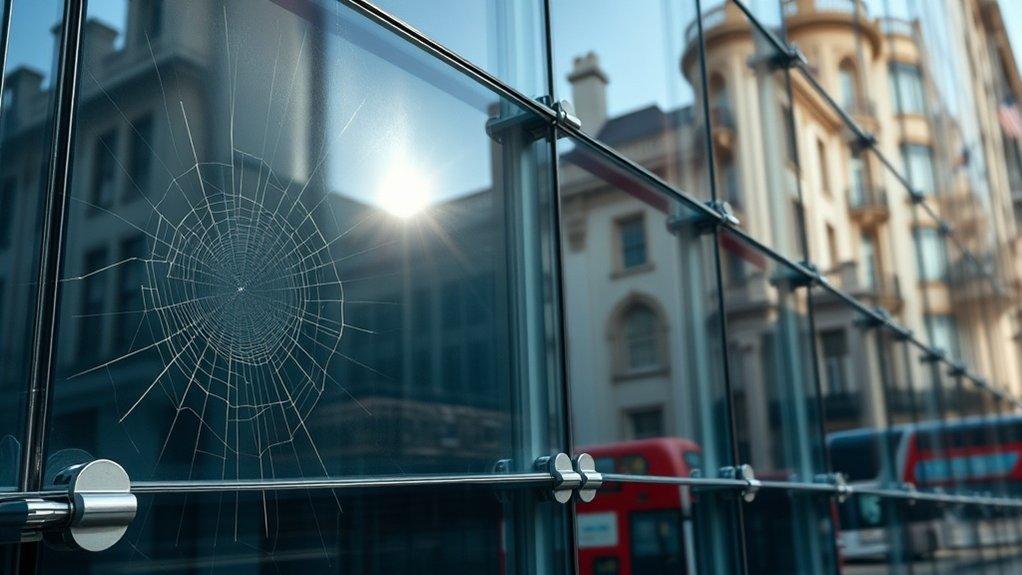
When a toughened pane fails, the stored energy is released across the whole sheet and it collapses into a heap of small, roughly cube-shaped granules. Injuries from those granules are usually minor, which is the behaviour BS EN 12600 tests for when it classifies glass for doors and low-level glazing. For Bedfont, TW14 customers this allows large, lightly framed panes without the risk of ordinary glass.
How Toughened Safety Glass Is Made
Processing happens at the factory in a fixed order. The pane is cut to final size, holes and notches for hinges or patch fittings are drilled, the edges are arrissed or polished and the sheet is washed. Only then does it go into the furnace, where the glass is brought to roughly 620 to 680 degrees Celsius, close to its softening point, then moved into a quench section where banks of air nozzles blast both faces at once. The skin hardens within seconds while the centre is still hot, and as the core contracts it pulls the surfaces into compression. We stress to every Bedfont customer that a toughened pane cannot be trimmed or drilled afterwards, so survey measurements must be right first time.
An optional heat-soak cycle to BS EN 14179 weeds out panes at risk of nickel sulphide breakage.
Key UK and Bedfont Regulations for Toughened Safety Glass
Two sets of rules govern safety glazing in Bedfont. The first is the Building Regulations, chiefly Approved Document K, which lists the critical locations where safety glass is compulsory: glazing in or beside a door within 1500 mm of the floor, and any other glazing below 800 mm.
The second set is product and design standards. BS EN 12150 covers manufacture and requires each pane to carry a permanent stamp. BS EN 12600 gives the pendulum impact class written as 1(C)1 or 2(C)2. BS 6262 says which class is acceptable where, and BS 6180 sets barrier loads and heights. We keep test certificates on file so you can show compliance to building control or a buyer's surveyor later.
Toughened Safety Glass vs Standard Glass in Bedfont, TW14
Annealed glass still has a place in high-level windows, cabinet shelving and some heritage sash repairs where nobody can fall against it. For anything in a critical location the comparison is not close: a toughened pane of the same thickness carries four to five times the load, tolerates far more thermal shock and fails safely, whereas annealed glass breaks into long daggers. The compromise is that toughened glass shows faint roller-wave marks and, under polarised light, grey blotches called anisotropy; neither is a defect.
Choosing the Right Toughened Safety Glass Thickness and Spec
Thickness is sized from the loads the pane will carry, not from taste. For a Bedfont job we look at wind pressure on external glazing, the line and point loads for anything acting as a barrier, the span between supports and whether people can walk into or on the panel. BS 6262 gives minimum thicknesses for common situations, and BS 6180 with BS EN 1991-1-1 sets barrier loads: 0.74 kN/m for a domestic landing, rising to 1.5 kN/m and beyond for shops and public areas.
As a rough guide, 6 mm covers most doors and side screens, 8 mm is usual for frameless shower enclosures, 10 mm for heavier frameless doors, and a laminated 10.8 mm or 12.8 mm make-up for balustrades. If the pane forms part of a double-glazed unit, the toughened leaf is combined with a low-E coating and argon fill so the unit meets the Part L limit of 1.4 W/m²K for replacement windows.
Toughened Safety Glass in Bedfont Homes
Victorian terraces with glazed front doors and fanlights, 1930s semis with low-silled bays and new-build flats with full-height glazing in Bedfont, TW14 all contain critical locations under Part K. A cracked pane in any of those positions must be replaced with safety glass even though the original was not.
- Balustrades and landing screens, which must resist the Part K line load and are usually laminated toughened so a broken panel does not leave an open drop.
- Glazed doors, side lights and French doors, which need a BS EN 12600 impact class and, on full-height glass, manifestation bands at 850 to 1000 mm and 1400 to 1600 mm.
- Rooflights, lantern roofs and glass floors, where the lower leaf is laminated for retention and the frame is thermally broken and drained.
Toughened Safety Glass in Shops, Offices and Fit-Outs
Shopfronts and partitions in Bedfont are hit by trolleys, cleaned daily and reconfigured every few years, and they are expected to carry branding and control privacy. The Workplace (Health, Safety and Welfare) Regulations require transparent screens to be safety material and clearly marked.
Compliance With Safety Standards
Every shopfront pane, door and partition needs a BS EN 12600 impact class, correct edge cover and manifestation where it could be mistaken for an opening. Older specifications still refer to BS 6206 classes A, B and C; we translate these into current EN classes so your documentation is consistent. Accept only UKCA or CE-marked glass with the BS EN 12150 stamp visible in a corner, and keep the batch records, heat-soak certificates and test reports in the building's O&M file.
Design Flexibility And Branding
A toughened pane can be laminated with a printed or coloured interlayer, screen-printed with ceramic frit fired on during toughening, or digitally printed with a logo, wayfinding or a privacy gradient. None of these reduce the impact class, provided the make-up is the one that was tested. For colour-critical work we start with low-iron glass, because the faint green of standard float shifts any back-painted RAL or Pantone shade.
Durability In High Traffic
A supermarket entrance in Bedfont takes thousands of trolley knocks a year, so we size commercial glass from the actual span, fixing pattern and crowd load rather than a catalogue minimum. Where a failed pane would leave a gap, we laminate two toughened leaves so the panel stays whole until replaced. The same approach applies to canopies and structural glazing.
Toughened Glass for Balustrades, Juliette Balconies and Roof Terraces
Glass barriers are the most demanding use of toughened glass we deal with in Bedfont. Design is governed by BS 6180 for loads and heights, BS 6262 for glass selection and BS EN 1991-1-1 for crowd loading on terraces.
Strength And Safety Standards
Approved Document K sets the barrier height at 1100 mm for external balconies and roof terraces and 900 mm for internal stairs and landings. BS 6180 then sets the line load, distributed load and point load, which differ between a private house, a block of flats and a bar terrace. For Bedfont work we almost always specify laminated toughened glass with a stiff ionoplast or PVB interlayer and documented heat-soak testing.
Design Options And Fixings
A base channel grips the bottom edge continuously and gives a frameless appearance. Side-mounted brackets bolt through the glass into the slab edge where there is no room for a channel. Bolt-through fixings need holes drilled to tight tolerances before toughening, so the setting-out drawing is agreed before anything goes to the furnace.
Weather Resistance And Longevity
For external glass in Bedfont, TW14 we prioritise:
- Heat-soaked, laminated toughened units, with a low-iron option where solar heating of a dark edge could stress the pane.
- Polished edges, drained channels and nylon or EPDM isolators so aluminium and stainless steel never sit in direct contact.
- A hydrophobic coating on exposed faces and a sealant tested with the chosen interlayer, so the panel is still clear and sound after many years.
Toughened Safety Glass for Shopfronts and Street-Level Glazing
Street-level glass on Bedfont high streets has three jobs: show the goods, satisfy Part K and BS 6262 for anyone who walks into it, and stand up to the occasional kick or attempted break-in. Heat-soaked panes are specified because an unexpected breakage at 3 am is costly for a trading business. For energy performance the toughened leaf is built into a sealed unit with a low-E or solar-control coating.
Privacy, Noise and Solar Control in Toughened Safety Glass
In a dense part of Bedfont, with traffic noise, overlooking neighbours and south-facing glass, the same toughened leaf can be built into a laminated or coated unit that also manages privacy, sound and heat:
- A tinted or low-iron toughened pane with a solar-control coating, which cuts the g-value and summer overheating while keeping daylight neutral.
- An acoustic PVB interlayer specified with BS EN 12758 in mind, which lifts the sound reduction and dampens the low rumble of buses and trains.
- Acid-etched, fritted or switchable PDLC layers for privacy, graded from opaque at eye level to clear above without reducing the pane's rating under BS EN 12150 and BS 6262.
Costs of Toughened Safety Glass in Bedfont
Toughened glass in Bedfont, TW14 costs more than annealed glass of the same size, and the gap widens with thickness, lamination, coatings and processing. A clear 6 mm door pane is a modest premium; a laminated low-iron balustrade panel with polished edges and heat-soak testing is a different order of cost. Against that, lifetime cost is usually lower: a toughened pane rarely needs replacing after an accidental knock, and a heat-soaked balustrade panel avoids an emergency callout.
It forms part of the specialist glass service we run across Bedfont. If this is not quite what you need, we also cover uv protective glass and stained glass repair.
Frequently Asked Questions
Can Toughened Safety Glass Be Cut, Drilled, or Resized After Manufacturing?
No. The toughening process locks a balance of surface compression and core tension into the pane, and any cut, hole or edge grinding releases it, shattering the glass immediately. All sizing, drilling, notching and polishing is done while the glass is still annealed.
Is Toughened Safety Glass Safe for Use in Bathrooms and Wet Rooms?
Yes, and it is the standard choice for shower screens, bath panels and wet-room dividers. Approved Document K treats low-level bathroom glazing as a critical location, so a toughened pane to BS EN 12150 with a BS EN 12600 impact class is required. We recommend heat-soak testing to BS EN 14179 for frameless screens because a spontaneous breakage in a wet room is unpleasant.
How Visible Are the Edges and Any Green Tint in Toughened Glass Panels?
Standard float glass contains a little iron, which gives the pane a faint green cast. It is barely noticeable through the face of a 6 mm pane but obvious along the edge, and a 12 mm or 15 mm balustrade panel shows a distinct green line. If you want a neutral result for a splashback, frameless screen or back-painted panel, ask for low-iron glass, which removes most of the tint at a modest extra cost.
Can Toughened Safety Glass Interfere With Mobile, Wi‑Fi, or Radio Signals?
Plain toughened glass has no measurable effect on phone, Wi-Fi or radio signals. The exception is coated glass: low-E and solar-control coatings contain thin metallic layers that reflect some radio energy, and buildings wrapped entirely in coated units can suffer weak mobile reception indoors. If this matters in a Bedfont office, we can specify coatings with a laser-etched pattern that restores signal, or leave the coating off selected panes.
Are There Eco-Friendly or Fully Recyclable Options for Toughened Safety Glass in Bedfont, TW14?
Glass is among the most recyclable building materials, and cutting offcuts go back into the float process as cullet. For a lower-carbon specification in Bedfont we can source glass from manufacturers who publish an Environmental Product Declaration and use high cullet content.
Summary
Toughened safety glass in Bedfont stops an everyday knock becoming an injury or an insurance claim. Specify it to BS EN 12150, size it for the real loads, insist on accurate measurement and careful fitting, and it will last for decades. If you are planning new doors, a balustrade, a shopfront or replacing a broken pane, call us for a free survey and a fixed quote.